Email : publicationjoy@gmail.com Phone : +91 7317200400

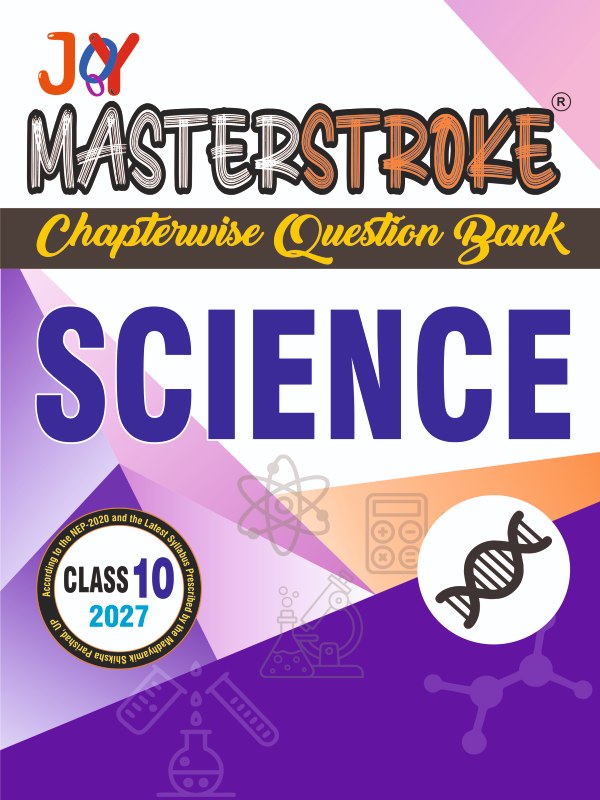
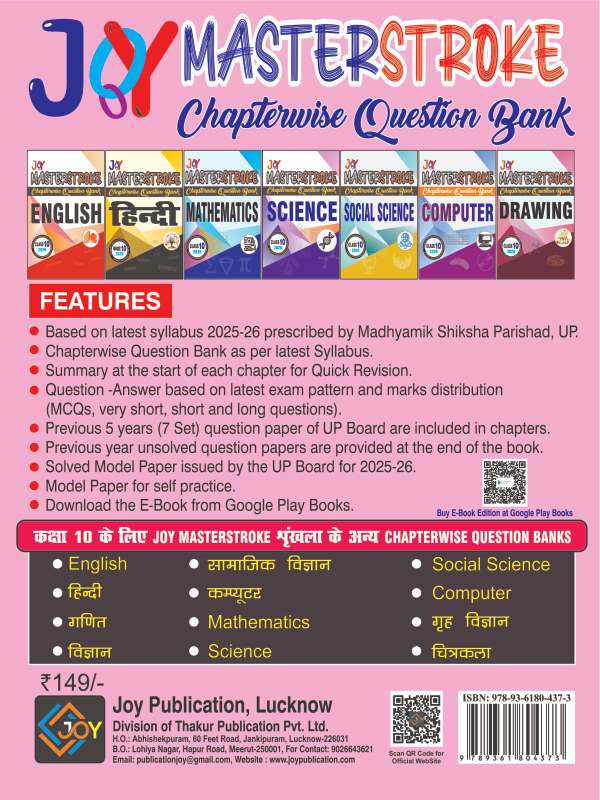
Masterstroke UP Board Science (English) Class 10 Exam 2027 | Chapterwise Question Bank | Model Papers, MCQs
₹149.00
“Joy Publication UP Board Class 10 Science Question Bank with chapter-wise notes, solved questions, model papers, and exam-focused practice for top exam success.”
ISBN : 9789361804373
Click below to buy the e-book edition:
Based on latest Syllabus 2025-2026
U.P. Board
Academic Session – 2025-26
Subject – Science
Class – 10
Syllabus
In this paper, there will be a Question Paper of 70 marks and Internal Assessment at the school level of 30 marks. Minimum passing marks are 23 and 10, a total of 33 marks.
Maximum Marks: 70
| S.No. | Unit | Marks |
| 1) | Chemical Substances – Nature and Behaviour | 20 |
| 2) | The World of Living | 20 |
| 3) | Natural Phenomena | 12 |
| 4) | Effects of Current | 13 |
| 5) | Natural Resources | 05 |
| Total | 70 | |
| Internal Assessment Work | 30 | |
| Grand Total | 100 |
Unit I: Chemical Substances – Nature and Behaviour (20 Marks)
Chemical Reactions: Chemical equation, Balanced chemical equation, implications of a balanced chemical equation, types of balanced chemical reactions: combination, decomposition, displacement, double displacement, precipitation, neutralisation, oxidation and reduction.
Acids, Bases and Salts: Their definitions in terms of furnishing of H+ and OH– ions. General properties, examples and uses, concept of pH scale (Definition relating to logarithm not required), importance of pH in everyday life; preparation and uses of sodium hydroxide, bleaching powder, baking soda, washing soda and plaster of Paris.
Metals and Non-Metals: Properties of metals and non-metals, Preparation and Properties of Ionic Compounds, reactivity series, basic metallurgical process, corrosion and its prevention.
Carbon Compounds: Covalent bonding in carbon compounds, Versatile nature of carbon, Homologous series, Nomenclature of carbon compounds containing functional groups (halogens, alcohol, ketones, aldehydes, alkanes and alkynes), difference between saturated hydrocarbons and unsaturated hydrocarbons, Chemical properties of carbon compounds (combustion, oxidation, addition and substitution reaction). Ethanol and ethanoic acid (only properties and uses), soaps and detergents.
Unit II: The World of Living (20 Marks)
Life Processes: ‘Living Being’. Basic concept of nutrition, respiration, transportation and excretion in plants and animals.
Control and Co-Ordination in Animals and Plants: Tropic movements in plants, introduction of plant hormones, Control and co-ordination in animals, Nervous system – Voluntary muscles and involuntary muscles, reflex action, Chemical co-ordination – animal hormones.
Reproduction: Reproduction in animals and plants (asexual and sexual) reproductive health – needs and methods of family planning, Safe sex and HIV/AIDS, Obstetric and reproductive health.
Heredity: Heredity; Mendel’s contribution – Laws for inheritance of traits, Sex determination (brief introduction).
Unit III: Natural Phenomena (12 Marks)
Reflection of light at curved surfaces, images formed by spherical mirrors, centre of curvature, principal axis, principal focus, focal length, mirror formula (derivation not required), magnification.
Refraction – laws of refraction, refractive index, Refraction by spherical lens, image formed by spherical lenses, rules for image formation by lenses, lens formula (derivation not required), Magnification, Power of a lens, Functioning of a lens in human eye, defects of vision and their corrections, applications of spherical mirrors and lenses.
Refraction of light through a prism, dispersion of light, scattering of light, applications in daily life.
Unit IV: Effects of Current (13 Marks)
Electric current, potential difference and electric current. Ohm’s law, Resistance, Resistivity, Factors on which the resistance of a conductor depends, Combination of resistors (series and parallel) and its applications in daily life, Heating effect of electric current, and its applications in daily life. Electric power, interrelation between P, V, I and R.
Magnetic Effects of Electric Current: Magnetic field, field lines, magnetic field due to a current-carrying conductor, magnetic field due to electric current carrying coil or solenoid; force on current-carrying conductor, Fleming’s Left-Hand Rule, Domestic electric circuits.
Unit V: Natural Resources (05 Marks)
Our Environment: Eco-system, environmental problems, Ozone layer depletion, waste production and their solutions. Biodegradable and non-biodegradable substances.
Practical
The practical exam will be evaluated internally at the school level. The marks distribution for the practical exam is as follows:
| Three Experiments | – | 2 × 3 | = | 06 Marks |
| Oral work | – | = | 02 Marks | |
| Sessional work | – | = | 03 Marks | |
| Total Marks | = | 11 Marks |
1 review for Masterstroke UP Board Science (English) Class 10 Exam 2027 | Chapterwise Question Bank | Model Papers, MCQs
Related products
-
Masterstroke UP Board Samajik Vigyan (Hindi) Class 10 Exam 2027 | Chapterwise Question Bank | Model Papers, MCQs
₹149.00 -
Masterstroke UP Board Mathematics (English) Class 10 Exam 2027 | Chapterwise Question Bank | Model Papers, MCQs
₹149.00 -
Masterstroke UP Board Grih Vigyan (Hindi) Class 10 Exam 2027 | Chapterwise Question Bank | Model Papers, MCQs
₹149.00 -
Masterstroke UP Board Drawing (English) Class 10 Exam 2027 | Chapterwise Question Bank
₹149.00
admin (verified owner) –
The book includes chapterwise questions, MCQs, and model papers.
It helps students understand concepts clearly and prepare effectively for exams.